
On 1 January 2026, amendments to the Corporate Income Tax Law and the Personal Income Tax Law came into force, introducing an alternative, voluntary split dividend tax regime for capital companies whose members are all natural persons. The new regulation changes the current approach to taxing distributed profits, providing for the distribution of the tax burden between companies and individuals, while maintaining freedom of choice for companies.
Overview of the changes
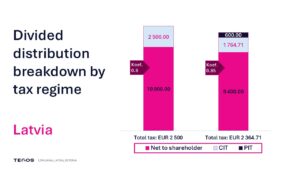
According to the amendments, a capital company that chooses to apply the alternative regime shall pay 15% corporate income tax (CIT) on distributed profits at the company level. In addition, a 6% personal income tax (PIT) shall be withheld from dividends paid to individuals, which is received by the local government where the person is registered. This regime is an alternative to the existing CIT regulation, under which distributed profits are subject to a 20% rate (applying a coefficient of 0.8 to the gross amount).
In the new regime, a coefficient of 0.85 is used to calculate distributed profits when determining the taxable object. This allows us to compare the 15% rate with the existing CIT system, where the effective tax burden is approximately 25%, i.e., the alternative regime results in approximately 17.6% CIT equivalent in practice. This comparison allows for a more accurate assessment of the fiscal impact of the new regime at the company level, while the total tax burden, including withheld PIT, should be assessed separately.
Rules and limitations
The application of the alternative regime is voluntary, but it is not selective, i.e., the tax regime is chosen by the company as a whole and applies to all profits distributed to all participants. A situation where some participants receive dividends under the existing CIT regime and others under the alternative regime is not acceptable. If a company has chosen the alternative regime, it applies to all dividends paid during the relevant tax period.
The new regime applies only to profits distributed as dividends. The amendments to the CIT law do not change the application of CIT to other profit-reducing expenses that are not dividends. This means that other objects subject to CIT (including expenses not related to economic activity) are taxed in accordance with the general CIT procedure, applying a 20% rate with a gross coefficient.
The choice of the new regime is linked to the taxation period. A capital company may switch to the alternative regime or opt out of it only at the beginning of a new tax year. No change of regime is permitted during the tax year, and the chosen regime is applicable to the entire profit distribution for the year in question. In practical terms, this means that the tax regime can be changed once a year.
Requirements and impact of capital structure
An essential condition for applying the alternative regime is the capital structure. The right to apply this regime exists only as long as all members of the capital company are natural persons. If a legal entity appears in the capital structure during the tax year, the company loses the right to apply the alternative regime with regard to future profit distribution from the moment when the aforementioned condition is no longer met. In this case, dividends paid after the legal entity’s entry into the capital are taxed in accordance with the general CIT regime.
An important aspect of the new regime is the withholding of personal income tax even if dividends are paid to a natural person who is a non-resident for tax purposes in Latvia. 6% PIT is withheld in Latvia on dividend payments regardless of the recipient’s country of residence. This is not a tax payable only in the country of residence, but rather PIT paid in Latvia at the individual level. The tax withheld may be used as a tax credit in the country of residence in accordance with the internal regulations of the respective country and the double tax treaties. In this respect, the alternative regulation is a significant innovation for foreign investors.
For example, if a shareholder of a capital company is a citizen of the United States, in accordance with the Latvian-US tax treaty, the 6% PIT withheld in Latvia on dividends may be used as a tax credit in the US tax return, reducing the tax payable in the US and avoiding double taxation. Under the current CIT regime, however, tax is paid only at the company level, and foreign individuals are not actually subject to income tax, which, under the convention, could be credited in their country of residence.
Internal documentation and corporate governance
Another practically important issue is where the application of the alternative regime should be provided for in the company’s internal documentation. The CIT law does not stipulate a mandatory requirement to include the choice of tax regime in the company’s articles of association. The application of the regime results from the actual conduct of the company and the fulfilment of its tax obligations in accordance with the law. However, for the sake of good corporate governance and legal clarity, it is advisable to regulate this issue in internal documents, such as a resolution of the shareholders’ meeting on the choice of tax regime, profit distribution procedure or dividends. This is particularly important in cases where there are several shareholders or when foreign investors are attracted to the company.
From the point of view of the tax burden, the new regime differs significantly from the previous one. Example with EUR 10,000 in distributed profits:
Conclusions
In conclusion, it should be noted that the regulations do not prohibit the application of the alternative tax regime to the company’s accumulated profits from previous years, but not distributed by 2026 (except for the portion of profits reported in CIT returns as earned by 2017 and not distributed as dividends). Since CIT in Latvia is applied at the time of profit distribution rather than at the time of profit generation, the decisive factor would be the tax regime applicable to the company during the taxation period when dividends are paid out. Consequently, if a company has opted for the alternative regime from 2026 and all the conditions for its application are met, it is considered that previously accumulated profits distributed as dividends after 1 January 2026, may be taxed in accordance with the new regulations.
